Christmas Lights Amp Draw Circuit (Safety Guide 2026)
Every December, we get calls from homeowners across the Metroplex who plugged in their holiday display and BAM, the breaker tripped. Understanding the Christmas lights amp draw of your circuit is the single most important thing you can learn before you string up a single strand. It keeps your home safe, your lights glowing, and your holiday stress-free.
At DFW Christmas Light Installs in Watauga, we have wired thousands of homes and businesses, and we have seen almost every electrical mistake in the book. In this guide, we will walk you through how many amps your lights pull, how to calculate your total load, and how to avoid the overloads that ruin holiday cheer.
How Many Amps Do Christmas Lights Draw?
The amp draw of your Christmas lights depends on two big factors: the type of bulb and the number of bulbs. Incandescent lights are the power hogs. They convert most of their energy into heat, which means they pull a LOT of current. LED lights, on the other hand, sip electricity. That is why you can string dozens of LED strands together without breaking a sweat.
A standard household circuit in Watauga, Hurst, or Fort Worth is usually rated for 15 or 20 amps. But you should never load a circuit to its full rating. The golden rule is the 80 percent rule, which means a 15-amp circuit should carry no more than 12 amps of continuous load. Here is a quick comparison of common light types and their typical draw.
| Light Type | Bulbs Per Strand | Approx. Amps Per Strand | Watts Per Strand |
|---|---|---|---|
| Incandescent Mini Lights | 100 | 0.34 amps | 40 watts |
| Incandescent C7 Bulbs | 25 | 1.04 amps | 125 watts |
| Incandescent C9 Bulbs | 25 | 1.87 amps | 175 watts |
| LED Mini Lights | 100 | 0.03 amps | 4 watts |
| LED C9 Bulbs | 25 | 0.05 amps | 6 watts |
Look at that difference. A single strand of C9 incandescent bulbs pulls nearly 2 amps. An entire strand of LED C9 bulbs pulls just a sliver of that. This is why the type of light you choose changes EVERYTHING about how many strands you can safely connect.
How to Calculate the Amp Draw of Your Christmas Light Display
Figuring out your total amp draw is not complicated math. You just need to know a few numbers off your light boxes or the manufacturer tags. Most strands list their wattage right on the packaging or on the small tag near the plug. Once you have that, the rest is simple. If you want a deeper breakdown of safe wiring practices, our team put together a full Christmas light installation safety guide that pairs perfectly with these calculations.
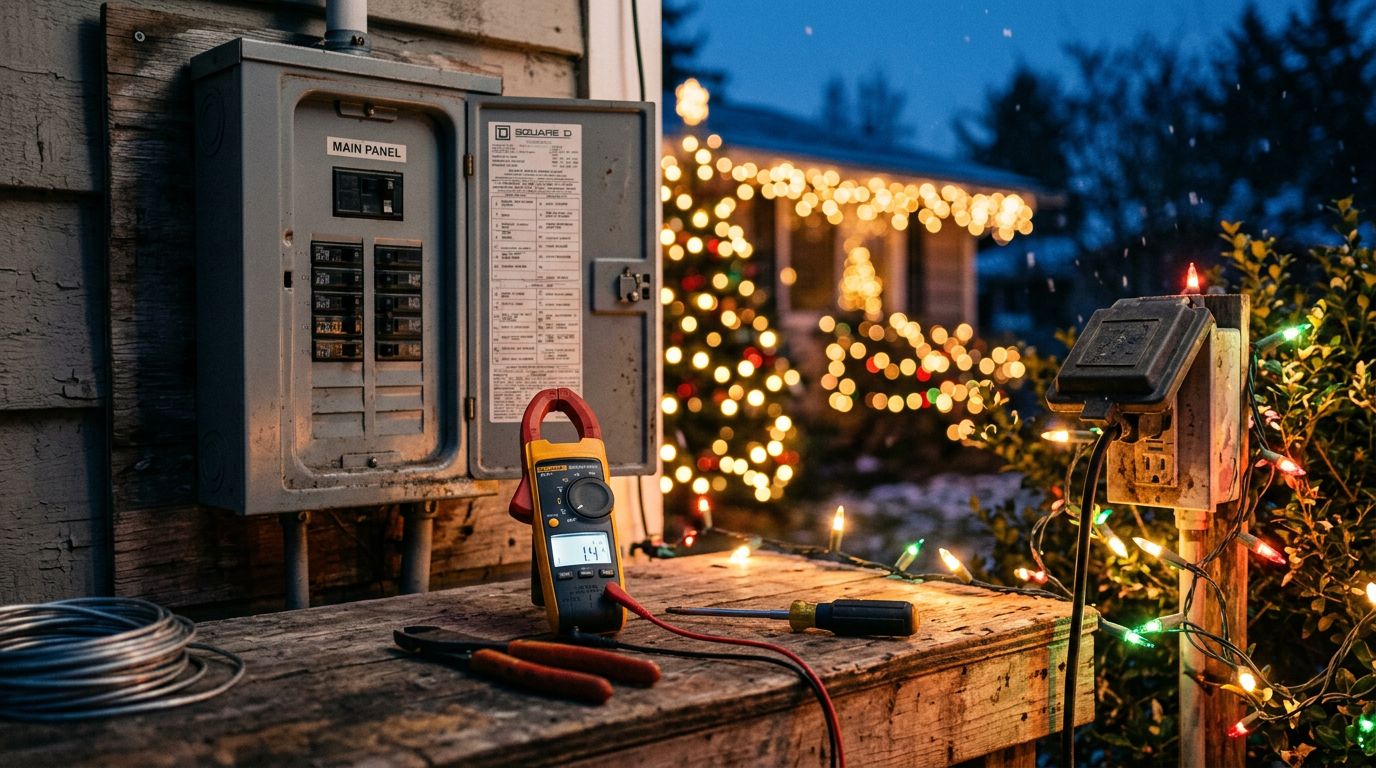
Here is the step-by-step process we use on every job site.
- Find the wattage of each strand. Check the box or the tag near the plug. If it lists amps instead of watts, you can skip to the totaling step.
- Add up all the wattage. Count every strand you plan to run and add their watts together. Do not forget inflatables, projectors, and wreaths.
- Divide total watts by your voltage. Household voltage in Texas is 120 volts. So the formula is Total Watts divided by 120 equals Total Amps.
- Compare to your circuit rating. Take the amp number and check it against your breaker. Remember the 80 percent rule.
- Leave a safety buffer. Never plan to hit the maximum. Give yourself room so a cold snap or power surge does not tip you over.
Here is a real example. Say you have ten strands of 40-watt LED lights. That is 400 total watts. Divide 400 by 120 and you get about 3.3 amps. That fits EASILY on a 15-amp circuit. Now run ten strands of 175-watt C9 incandescents. That is 1,750 watts, which divided by 120 equals roughly 14.6 amps. That already blows past the safe limit for a single 15-amp circuit.
How Many Christmas Light Strings Can You Connect Safely?
This is the question that trips people up most often, literally. Every strand of lights has a maximum number of connections you can string end to end. Going over that number is dangerous because the current from every downstream strand flows through the wires of the FIRST strand. Overload those wires and you get heat, melted plugs, and fire risk.
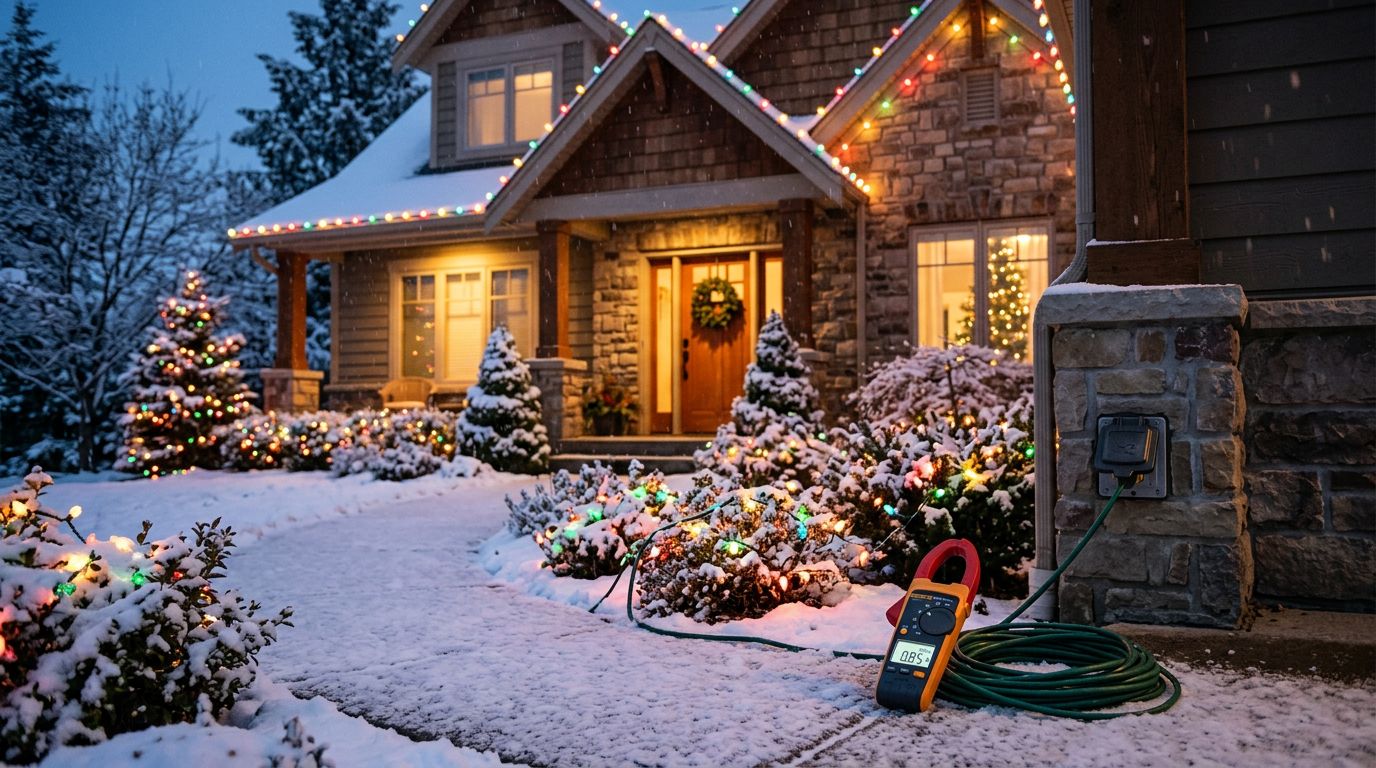
The safe number depends entirely on bulb type. Here is what we tell our customers in Colleyville, Euless, and Arlington.
- LED mini lights: You can usually connect 40 to 50 strands end to end. LEDs draw so little that the limit is often the wire gauge, not the current.
- Incandescent mini lights: Stick to a maximum of 3 to 5 strands connected together. After that, run a new line back to the outlet.
- C7 and C9 incandescent bulbs: These pull heavy current. Limit yourself to 2 or 3 strands per connection at most.
- Mixed displays: Never assume. Always add up the wattage of every connected strand and check it against the max rating on the first strand.
- Check the fuse rating: The plug on most strands has a tiny fuse. That fuse tells you the real limit for that product line.
For big displays, we spread the load across multiple outlets and circuits instead of daisy-chaining everything into one plug. This is especially important for synchronized shows where timing and steady power matter. If you run animated lighting, our tips on synchronized Christmas light maintenance explain how to keep power distribution clean and reliable all season.
What Circuit Breaker Size Do You Need for Holiday Lighting?
Choosing the right circuit and knowing your breaker size is the backbone of a safe display. Most home circuits are already in place, so the goal is matching your light load to what those circuits can handle. Let us break it down by breaker size.
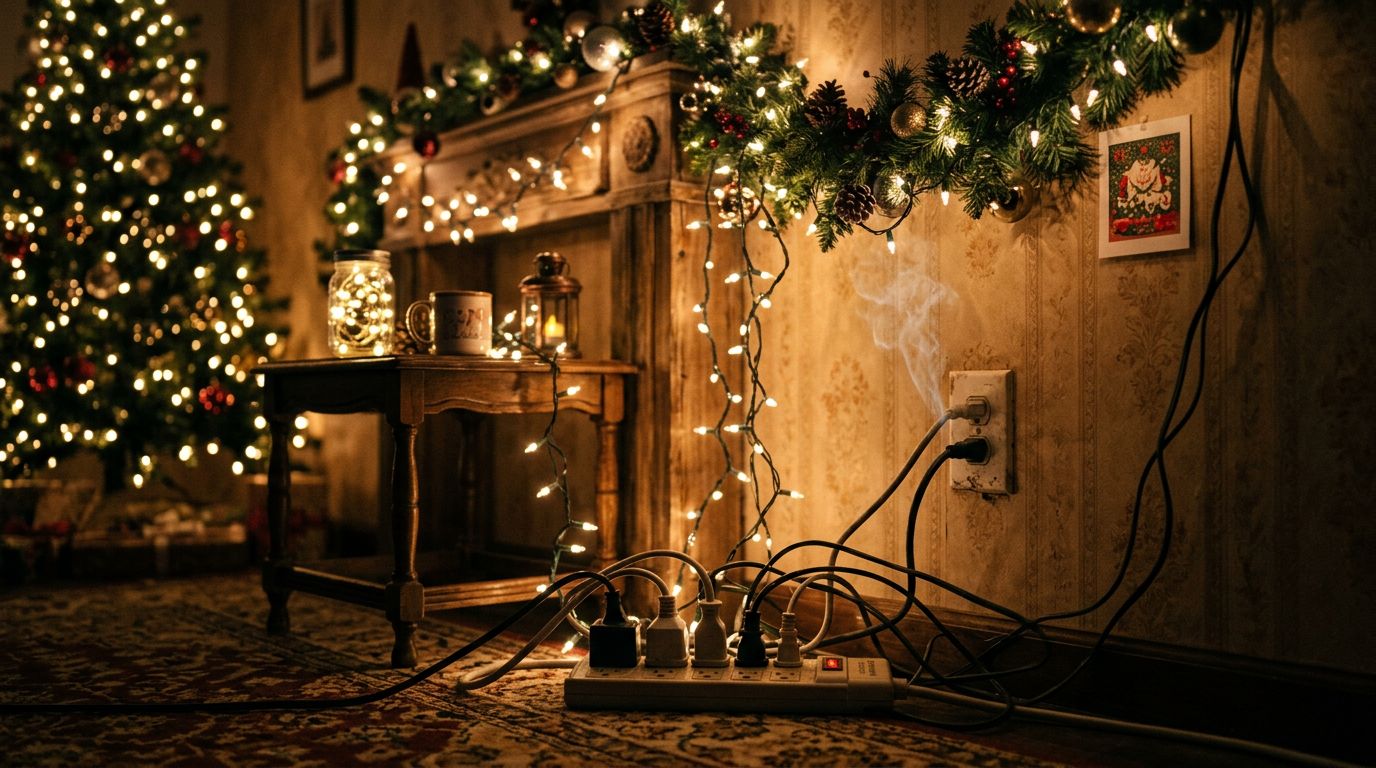
15-Amp Circuits
These are the most common circuits in older Watauga and Richland Hills homes. Following the 80 percent rule, you get 12 usable amps, or about 1,440 watts. That is plenty for LED displays but fills up fast with incandescents.
20-Amp Circuits
Newer homes and garages often have 20-amp circuits. These give you 16 usable amps, or roughly 1,920 watts of safe capacity. Outdoor GFCI outlets are frequently on these heavier circuits.
Dedicated Circuits for Big Displays
If you run a large commercial display or a whole-roof residential setup, a dedicated circuit is worth the investment. It keeps your holiday lighting off the same line as your fridge, microwave, or garage door. That means fewer surprise trips and steadier power.
GFCI Protection Is a Must
Every outdoor outlet feeding your lights should have GFCI protection. It shuts off power the instant it detects a fault, which protects against shocks from rain, snow, and damaged cords. In North Texas weather, this is NON-NEGOTIABLE.
Spread the Load
Even if one circuit could technically handle your entire display, we recommend splitting it. Two circuits at 60 percent each are far safer and more reliable than one circuit at the edge of its limit.
LED vs Incandescent Christmas Lights Amp Draw
If there is one upgrade we recommend to every customer, it is switching to LED. The amp draw difference is not small. It is HUGE. LEDs use up to 90 percent less energy than incandescent bulbs, which slashes your electric bill and lets you build a much bigger display on the same circuits. They also run cool, which reduces fire risk and makes them safer around dry roofing and greenery.
Here is a side-by-side look at what that difference means in real numbers on a typical display.
| Factor | Incandescent | LED |
|---|---|---|
| Amp Draw Per 100 Bulbs | 0.34 amps | 0.03 amps |
| Max Strands Connected | 3 to 5 | 40 to 50 |
| Heat Output | High | Very Low |
| Energy Cost Per Season | Higher | Up to 90% Lower |
| Lifespan | 1 to 3 seasons | 7 to 10+ seasons |
| Circuit Overload Risk | High | Low |
Incandescent lights still have that warm nostalgic glow some folks love, and there is nothing wrong with that. But if you want a large, worry-free display, LED is the clear winner on safety and cost. Many of our customers ask whether upgrading and hiring pros is really worth it, and we cover exactly that in our honest look at whether professional Christmas lights are worth it.
Common Christmas Light Circuit Overload Mistakes to Avoid
We see the same handful of mistakes every single season, and almost all of them lead to tripped breakers or worse. The good news is that they are all easy to avoid once you know what to watch for. Take a few minutes before you plug in and you will save yourself a headache in December.
- Daisy-chaining too many strands. This is the number one cause of overloads. Just because plugs fit together does not mean it is safe to connect them.
- Ignoring the wattage on inflatables and projectors. These devices pull real power and are easy to forget when you add up your load.
- Running everything from one outlet. Piggybacking your entire display on a single plug guarantees trouble. Spread it out.
- Using indoor extension cords outside. Indoor cords are not rated for cold, moisture, or heavy loads. Always use outdoor-rated cords with the proper gauge.
- Mixing LED and incandescent on the same run. The incandescents can overload the run before you ever reach the LED limit.
- Skipping GFCI protection. An outdoor outlet without GFCI is a shock hazard waiting for the first rainstorm.
- Overlooking the strand fuse rating. That tiny fuse in the plug is your first line of defense. Never bypass it or replace it with a bigger one.
- Assuming LED means unlimited. LEDs are efficient, but they still have connection limits. Check the box.
Avoid these traps and your display will run smoothly all season long. When in doubt, add up your numbers and stay under 80 percent of your circuit rating. That buffer is your friend, especially during a cold Texas snap when everything is running hard.
Conclusion
Understanding your Christmas lights amp draw is the difference between a flawless holiday display and a frustrating night of resetting breakers. Remember the basics: know your wattage, divide by 120 to get amps, stay under 80 percent of your circuit rating, and lean on LEDs whenever you can. Limit how many strands you connect, protect every outdoor outlet with GFCI, and spread your load across multiple circuits for peace of mind.
If crunching numbers and climbing ladders is not how you want to spend your December, let the pros handle it. At DFW Christmas Light Installs, we design, install, and power safe displays for homes and businesses across Watauga, Hurst, Euless, Richland Hills, Colleyville, Fort Worth, Arlington, and Dallas. Reach out today and let us light up your season the SAFE way.